Many companies still rely exclusively on email marketing as their primary digital communication channel. And not without reason—email is versatile, allows rich content, and has virtually zero sending costs. But when we look at real performance numbers, SMS stands out impressively in metrics that truly matter: open rate, speed, and conversion.
In this article, we will compare SMS and email marketing based on real data collected from thousands of campaigns. The numbers will surprise you—and likely change the way you think about your communication strategy.
The Numbers That Don't Lie
Let's start with the most objective comparison possible—pure performance data:
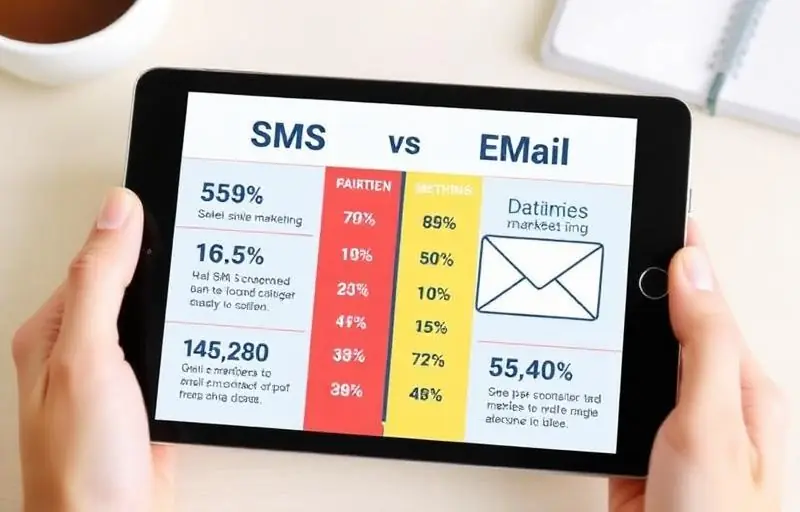
Open rate: SMS 98% vs Email 20%
This means that for every 10,000 messages sent, 9,800 SMS will be read compared to just 2,000 emails. The difference is nearly 5x.
Average reading time: SMS 3 minutes vs Email 6 hours
90% of SMS messages are read within the first 3 minutes of receipt. Emails, on average, take 6 hours to be opened—if they get opened at all. Many sit in the inbox for days or weeks.
Click-through rate: SMS 19% vs Email 2.5%
When we include links in messages, SMS generates nearly 8x more clicks. This translates directly into more website visits, more product views, and more conversions.
Response rate: SMS 45% vs Email 6%
When we request an action from the recipient (reply, rate, confirm), SMS generates 7.5x more responses. Ideal for satisfaction surveys, confirmations, and interactions.
Opt-out rate: SMS 1% vs Email 0.5%
SMS has a slightly higher unsubscribe rate, which is natural given that it is more intrusive. But 1% is an extremely healthy number, indicating that, when done correctly, people want to receive your messages.
Why Is the Difference So Big?
The massive difference in performance between SMS and email is explained by several behavioral and technological factors:
Spam filters: Email services like Gmail, Outlook, and Yahoo aggressively filter marketing emails. Even legitimate emails often land in the "Promotions" tab or directly in spam. SMS doesn't have this filter—every message reaches the recipient directly.
Email overload: The average person receives 121 emails per day. It is humanly impossible to read them all. The result is that most are deleted without ever being opened. With SMS, however, the average person receives 5 to 10 per day, making each message far more visible.
Immediate notification: SMS appears as a push notification on the mobile screen, often even before the user unlocks their device. Emails, by default, are silent on many devices.
Behavioral habit: People are conditioned to check SMS immediately—it could be an urgent message, a verification code, or a bank alert. This instinct guarantees high open rates.
When to Use SMS vs When to Use Email
Although SMS outperforms email across key metrics, each channel has its ideal moment. Using the right channel in the right situation is what separates average strategies from exceptional ones.
When to Use SMS
Short-deadline promotions: "Today only: 40% OFF!"—when urgency is real, SMS is unbeatable. Being read within 3 minutes ensures that customers learn about the promotion in time.
Confirmations and reminders: Order confirmations, appointment reminders, due date notices. Messages that customers need to see quickly.
Urgent alerts: Schedule changes, cancellations, security notices. When every minute counts, SMS is the only reliable channel.
Verification codes (2FA): SMS is the industry standard for two-factor authentication due to its reliability.
Quick surveys: "How was your experience? Reply from 1 to 5"—SMS generates a 45% response rate.
Inactive customer reactivation: An SMS to a customer who hasn't purchased in months is more effective than any reactivation email.
When to Use Email
Newsletters and long-form content: Articles, detailed updates, educational content requiring more than 160 characters.
Visual catalogs: When you need to showcase products with images, detailed descriptions, and multiple links.
Formal communications: Contracts, terms of use, official documents that need to be recorded.
Customer onboarding: Educational sequences on how to use your product or service, complete with videos and tutorials.
Detailed receipts and invoices: Documents that require complex formatting and attachments.
Cost-Benefit Analysis
Let's do the math with a real-world scenario:
Scenario: Campaign for 10,000 Contacts
SMS:
Email:
Although the percentage ROI of email is similar (due to virtually zero cost), SMS generates 12x more absolute revenue in the same campaign.

The Ideal Multichannel Strategy
The best results come from a smart combination of SMS and email. Here is a framework that works:
Day 1: Email with detailed content about the promotion (images, descriptions, multiple products)
Day 2: Short SMS for those who didn't open the email: "Did you see our promotion? 40% OFF until tomorrow: {link}"
Day 3 (last day): Urgent SMS: "Last chance! The promotion ends tonight at midnight: {link}"
This approach combines the rich content of email with the guaranteed delivery of SMS, maximizing both reach and conversion.
Future Trends
SMS marketing is not stuck in the past. New technologies are emerging:
RCS (Rich Communication Services): An evolution of SMS that supports images, buttons, and carousels. Already available on various Android devices, it promises to bring together the best of SMS (guaranteed delivery) and the best of email (rich content).
Artificial Intelligence: AI is being used to optimize send times, personalize messages, and predict the best CTA for each audience segment.
Omnichannel integration: Platforms that unify SMS, email, WhatsApp, and push notifications into a single, cohesive strategy.
Practical step-by-step guide to integrating SMS and Email into your routine
To put into practice a strategy that combines the visual appeal of email with the immediate agility of SMS, it is essential to follow a structured workflow. This organization prevents message overload and ensures that the recipient receives the right communication on the most convenient channel.
List hygiene and validation: Before any blast, filter your contact list to remove invalid numbers, deactivated inboxes, and records of those who opted out. Working only with valid contacts reduces unnecessary costs and improves deliverability.
Segmentation by consumer profile: Divide the audience into groups according to purchase history, order frequency, or categories of interest. A contextualized message generates a much stronger connection than generic blasts to the entire list.
Defining the primary channel by objective: Choose the starting point according to the nature of the campaign. Use email for launches that require visual product presentations or detailed explanations; use SMS as the initial touchpoint when there is urgency, an approaching expiration date, or short-term offers.
Link and landing page tracking: When including links in SMS messages, use custom shorteners and campaign tracking parameters. This allows you to identify exactly how many visits and conversions came from each channel.
Automation with fallback workflows: Set up automated workflows where SMS acts as support. If an important promotional email is not opened within 24 hours, the system triggers a concise SMS alerting them about the opportunity before it expires.
Ready-to-use message templates for today
Writing an SMS requires the power of synthesis: every word must have a clear purpose within the standard 160-character limit. Check out practical templates for different stages of the customer relationship:
Abandoned cart recovery:
"Hi, [Name]! The items in your bag are still reserved. Complete your order today with special conditions by visiting: [link]"
Limited-time offer notice:
"[Name], flash opportunity: discounts of up to 30% on selected products only until 10 PM. Take advantage now: [link]"
Appointment or service reminder:
"Reminder: your appointment is booked for tomorrow, [Date], at [Time]. Reply 1 to confirm or 2 if you need to reschedule."
Due date bill or invoice alert:
"[Name], your invoice is due today. Access the duplicate slip and barcode directly on your phone to avoid interest: [link]"
Post-service satisfaction survey:
"How was your experience with [Company]? From 1 to 5, how would you rate our service? Reply for free."
Inactive customer reactivation:
"We miss you, [Name]! We've unlocked a special R$ 20 coupon for your next order over R$ 100. Use VOLTEI on our website: [link]"
Common mistakes that harm your campaigns
Even with established channels, operational slip-ups reduce return on investment and drive consumers away. Watch out for the most common mistakes:
Sending outside business hours: Sending promotional messages too early in the morning, late at night, or during rest periods irritates customers and increases block or opt-out requests. Always prefer business hours, between 9 AM and 8 PM.
Lack of sender identification: Since SMS is often delivered via shared numbers or short codes, forgetting to include your company name in the text causes immediate distrust and makes the message look suspicious.
Lack of a direct call to action: Vague copy leaves the reader unsure of the next step. Always conclude with direct and simple instructions, such as "visit," "check out," "take advantage," or "reply."
Excessive abbreviations and truncated words: Trying to save space by cutting too many letters cheapens communication and hinders understanding. Keep the text correct, clear, and professional.
Excessive sending frequency: Sending messages every day exhausts the recipient's patience. The mobile channel is personal and should be reserved for alerts that truly add immediate value.
Frequently asked questions about SMS and Email Marketing
Is customer authorization required to send commercial SMS?
Yes. Brazilian legislation, including the LGPD, requires the explicit consent of the data subject to send advertising messages. Keep opt-in records and always respect unsubscribe requests to maintain your company's compliance.
How do you know which of the two channels performed better in a joint campaign?
Tracking should be done by comparing equivalent metrics: total cost invested in each channel, volume of visits generated to landing pages via tracked links, and total completed orders originating from each source.
What is the recommended sending frequency for promotional SMS?
For promotional campaigns, one to two sends per week are usually enough to keep the brand top of mind without invading the customer's routine. On the other hand, transactional communications, such as confirmations and security codes, can happen whenever requested.
Can sending SMS with links be affected by carrier filters?
Generally not, as long as the message follows trusted standards: use of transparent shorteners, absence of terms associated with fraud, and clear identification of the sending company.
Conclusion
SMS and email are not competitors—they are complementary. Use SMS for urgency and immediate conversion, and email for nurturing and long-form content. But if you have to choose just one channel, the numbers are clear: SMS delivers 5x higher open rates, 8x more clicks, and generates significantly more revenue per campaign.
With SMS at R$ 0,06 on SMS Grátis Online, the cost-benefit ratio is unmatched. Test, measure, and scale—the results will speak for themselves.