Email marketing has been around for over 30 years and remains a pillar of digital marketing. But the numbers tell a concerning story: the average open rate for marketing emails in Brazil is only 18-22%, and it continues to drop. Meanwhile, SMS keeps its open rate steady at 98%.
This doesn't mean email is dead — it means each channel has its role. Let's compare them in detail so you can better invest your marketing budget.
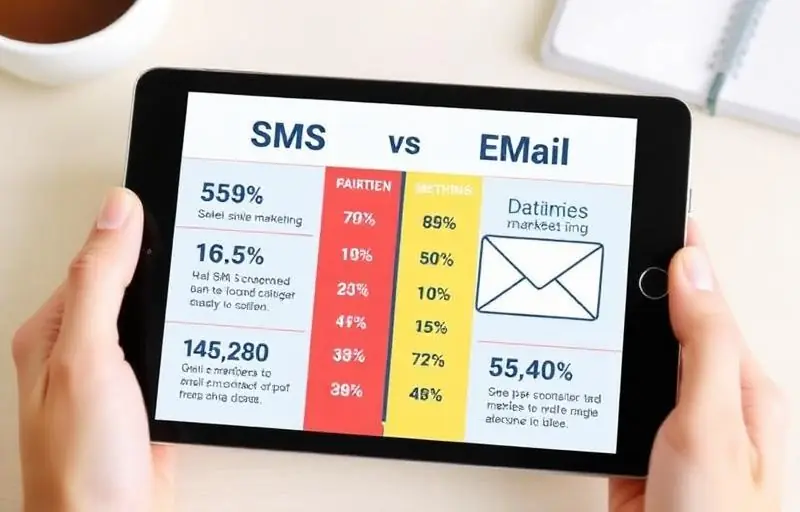
The numbers side by side
Open rate
SMS: 98%
Email: 18-22%
This means that for every 100 messages sent, 98 SMS messages will be read compared to only 20 emails. For urgent communications, this difference is decisive.
Time to read
SMS: 90% read within 3 minutes
Email: 50% read within 6 hours (if they are read at all)
Click-through rate (CTR)
SMS: 19-36%
Email: 2-5%
Conversion rate
SMS: 8-15%
Email: 1-3%
Cost per message
SMS: R$ 0,06
Email: R$ 0,005-0,02 (via platform)
Cost per conversion
SMS: R$ 0,40-0,75
Email: R$ 0,50-2,00
Yes — even though email is cheaper per send, SMS has a lower cost per conversion because of its vastly superior rates.
Spam and deliverability
SMS: 0% spam (delivered straight to the mobile phone)
Email: 10-30% land in spam or promotions
When SMS wins
1. Urgency and timing
Flash sales, lightning deals, last minute — when minutes matter, only SMS guarantees immediate reads.
2. Confirmations and reminders
Appointments, deliveries, due dates — SMS is 5x more likely to be seen in time.
3. Audiences without professional email
Customers who do not check email regularly (local commerce, 45+ audience).
4. Message simplicity
Direct offer, discount code, short reminder — no need for elaborate design.
5. Collections and billing
Payment reminders are more effective via SMS — urgency + immediate action.
When Email wins
1. Long and rich content
Newsletters, articles, guides — email supports HTML, images, and complex layouts.
2. Lead nurturing
Educational sequences of 5-10 emails over several weeks.
3. Cost at extreme volume
For 100,000+ regular sends, email is significantly cheaper.
4. Visual e-commerce
Product catalogs with photos, descriptions, and purchase buttons.
5. Complex segmentation
Sophisticated automations based on browsing behavior.
The ideal strategy: SMS + Email
Complementary model
Email to educate, SMS to convert:
1. Email: Weekly newsletter with educational content
2. Email: 5-email nurturing sequence
3. SMS: Direct offer when the lead is warm
Email for content, SMS for urgency:
1. Email: "New winter collection — check out the looks"
2. SMS: "⚡ Last 6h! 50% OFF winter collection. Hurry: {link}"
Email for segmentation, SMS for action:
1. Email: Identify who opened and didn't purchase
2. SMS: Send a direct offer to these contacts
Example integrated flow
1. Lead signs up → Welcome email (content)
2. Day 3 → Educational email about the product
3. Day 5 → Email with customer testimonials
4. Day 7 → SMS with a special offer + deadline
5. If they don't convert → Last chance email
6. If they convert → Confirmation SMS + email with details
Real comparative metrics
Companies using both channels with SMS Grátis Online:
Case Study: VitaForce Supplement Store
VitaForce, a supplements e-commerce with 15,000 customers:

Tips for combining SMS and Email
1. Do not send the same message on both channels: Each has its own format and purpose
2. Use email to segment, SMS to act: Identify interest via email, convert via SMS
3. Respect frequency: 2-4 SMS/month + 4-8 emails/month is a healthy balance
4. Measure separately: Compare the ROI of each channel to adjust investment
5. SMS for email recovery: If the email wasn't opened, send an SMS
6. Unify your database: The same CRM managing both channels
Practical SMS templates to use alongside Email
Integrating both channels requires direct messages that respect screen space on mobile phones and drive quick action after an email has been viewed. Here are some ready-to-use examples to adapt to your workflow:
Abandoned cart recovery:
"Hello, [Name]! We noticed your items are still reserved. Complete your order today using the coupon COMEBACK10: [link]"
Notice of exclusive content sent by email:
"[Name], we just emailed you our exclusive material on [topic]. Check your inbox and enjoy!"
Urgency prompt following an email campaign:
"Final hours, [Name]! The special offer sent to your email ends at 11:59 PM. Secure yours here: [link]"
Payment due date reminder:
"[Name], your order is almost approved! Your payment slip is due today. To quickly access a duplicate slip, click here: [link]"
Re-engagement of inactive contacts:
"We miss you, [Name]! We've put together an exclusive deal for you to shop with us again: [link]"
Common mistakes when trying to combine Email and SMS
Even with an understanding of the conceptual differences, several frequent missteps can jeopardize message reach and profitability:
Repeating the exact text across both channels: SMS should not be an abridged copy of the email sent at the exact same time. Each channel must serve a specific purpose within the customer journey to avoid overwhelming the recipient.
Failing to identify the brand within the message: In an email, the logo and sender address immediately identify the company. In an SMS, forgetting to include the brand name right at the beginning creates distrust and drives down click-through rates.
Working with outdated contact lists: Sending campaigns to nonexistent contacts or numbers that have changed wastes credits unnecessarily. Keeping your database clean and scrubbed is vital for maintaining reliable metrics.
Neglecting send frequency: Sending short messages every day annoys your audience and drives up opt-out or blocking requests. The secret to SMS effectiveness lies in strategic, well-timed delivery.
Using long links without a URL shortener: Long URLs consume valuable character counts needed for your offer and look careless. Shorteners keep the presentation clean and enable click tracking.
Key metrics to track
To evaluate the synergy between both tools and understand where your budget yields the greatest return, keep a close eye on these indicators:
Actual delivery rate: Reveals how many messages actually reached the recipient. It helps pinpoint contact list issues, such as full email inboxes or inactive phone numbers.
Unique click-through rate: Shows how many people received the link and decided to open it. It indicates whether the call to action was persuasive and whether the offer sparked immediate interest.
Unsubscribe rate: Measures the volume of contacts who opted out of the list. A sudden spike indicates that sending frequency may be too aggressive or that segmentation has failed.
Time to conversion: Measures the window of time between message delivery and order completion. It clearly highlights the superior immediacy of SMS compared to the more spread-out response typical of email.
Frequently asked questions about the combined strategy
Should I send the SMS before or after the marketing email?
In most lead nurturing and sales funnels, email comes first to present the message in detail using images and comprehensive copy. SMS is triggered later as a deadline reminder or follow-up alert to re-engage users who showed interest but did not complete a purchase.
How many SMS messages can I send per month to each contact?
For promotional and sales campaigns, keeping frequency between 2 and 4 messages per person each month preserves engagement without wearing out the relationship. Operational and transactional messages, such as delivery updates or verification codes, can be sent whenever triggered by an action.
Is it mandatory to shorten links in text messages?
While not a technical requirement, shortening links is essential in practice. Doing so saves portions of the standard 160-character limit, improves the visual appearance on the recipient's device, and allows for accurate click tracking within your management platform.
Conclusion
Email and SMS are not competitors — they are partners. Email is the channel for relationship building and education; SMS is the channel for action and conversion. Companies that use both strategically achieve significantly superior results compared to those relying on just one channel.